This Business Plan for the year ahead underlines the challenges faced by the Bar Standards Board (BSB). The plan will deliver the first year of our new strategy to be launched later this year and is based on two underlying principles. To stabilise, strengthen and improve performance across our frontline services and to consider where we need to reset and evolve for longer-term success.
A programme of process and technology changes aimed at providing the structural underpinning to a step change in performance will be completed by the end of 2026/27.
However, this alone will not deliver the step change required in performance.
To achieve operational excellence and to enable confidence in the BSB, we need consistent improvements across all our core activities, including quality, cost and timeliness.
We are putting in place process and resource solutions that will enable greater agility and to establish a high-performance culture focused on outcomes and supported by clear measures of success.
Challenges remain across our standards and authorisations operations including current backlogs and concerns around education and progression. Continuing our work to review and resolve these challenges are priorities for us over the next year.
The Board is focused on establishing operational excellence and creating a regulatory system that operates effectively with the aim of significantly reducing the cost of our operational work in the coming years. The BSB will also seek opportunities alongside the wider legal services sector in support of the growth ambitions for the UK economy.
We have made good progress and in the year ahead, we will continue our work in collaboration with the Bar Council and the newly appointed Conduct Commissioner as we support the broader cultural change challenge highlighted in the Harman Report on bullying and harassment at the Bar.
Professor Christopher Bones, Chair of the Bar Standards Board
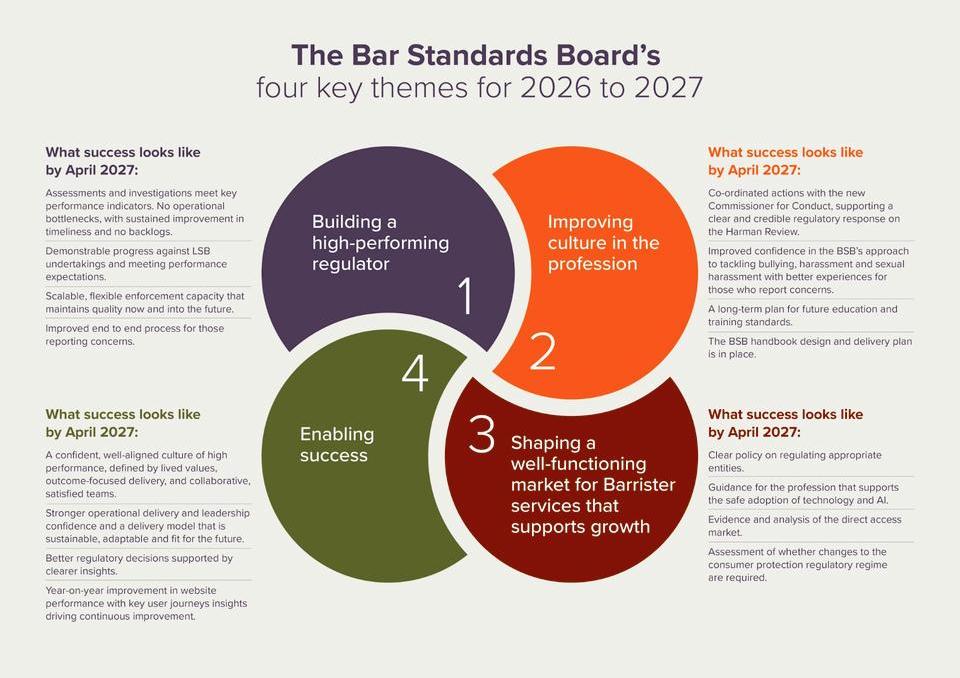
Four key themes will guide our work for the year ahead:
 Download our 2026/27 Business Plan
Steven Haines, Interim Director General of the Bar Standards Board
In the last year, the Bar Standards Board (BSB) has come under pressure as the volume and complexity of reports about barristers have increased. The use of AI is now a contributing factor in driving reports. A consequence has been that while the quality of our decision-making remains consistently high, our efficiency and timeliness targets have not been fully met.
This culminated in July last year in the BSB agreeing to voluntary undertakings given to the Legal Services Board (LSB) to improve operational performance. A key priority in 2026/27 for the BSB must be in surpassing targets to eradicate our operational backlogs and achievement of our key performance indicators.
We are putting renewed focus on operational delivery through the appointment of a Chief Operations Officer (COO) with accountability for all regulatory operational functions. We will increase our resilience in the face of fluctuating volumes of work across all our front-line services, bringing organisational improvements in effectiveness and efficiency.
By the end of the year, we expect to have hit new timeliness targets in our assessment, investigations and enforcement of cases and in our authorisations work. We will do this by investing in people and resources, changes to our ways of working, outsourcing some of our work on our less complex investigations and by building better processes and systems to handle and manage capacity in casework.
Alongside these operational priorities, we shall continue to build our understanding of how the barrister market is changing to inform our strategy to be taken forward across the second half of the decade. As part of this work, we shall review our current approach to education and training at the Bar to ensure an adequate and diverse future supply of barristers who fully meet the professional and ethical standards the public should expect.
We are committed to working with the profession and our stakeholders in driving high standards at the Bar in England and Wales, promoting an effective and competitive market that provides better access and
the opportunities that safe adoption of new technologies, particularly AI, can bring.
I want to thank our committed colleagues who continue to deliver our operations amongst the backdrop of the reforms and changes required to make the BSB an effective regulator that delivers excellence in the public interest.
In addition, I would like to thank Mark Neale the outgoing Director General who retired at the end of March for his leadership of the BSB as an independent regulator over the last 6 years.
The focus last year was on our ongoing reforms of our end-to-end operating model involving changes to systemise our processes to create increased efficiency. Our target date for implementation currently remains the end of December 2026.
A key part of our reform programme, to give effect to the recommendations of the independent Fieldfisher review was our consultation on proposed changes to our Enforcement Regulations last summer. We received broad support for these proposals aimed at enhancing our enforcement processes which included measures to better protect those who report cases of bullying, harassment and sexual harassment.
Another part of reform saw the BSB upgrade our IT systems that support our enforcement process. We have already implemented 7 out of 14 key changes that have delivered improvements in operational efficiency and regulatory compliance in the way that we handle and allocate cases. Once all regulation and supporting system changes are in effect, we expect our investigations to be completed more quickly.
Another Fieldfisher recommendation, saw the BSB implement a knowledge management strategy and launch a knowledge hub last year. It brings together key information and resources and helps support the BSB make informed, consistent high-quality decision-making across our regulatory decision-making teams.
We continued our focus on education and training in setting and maintaining standards at the point of authorisation. We also ensured that barristers maintained their skills and knowledge by monitoring their commitment to Continuous Professional Development (CPD).
We will continue our work on technology adoption and use at the Bar. We published a report in April 2025 highlighting the challenges and opportunities barristers face in adopting technology and have set up a joint working group with the Bar Council. In May 2025 we published key regulatory data about the barrister profession to make it more accessible to the public. This included practising barrister numbers, areas of practice, locations and demographic data which is updated monthly.
Also in May 2025, we consulted on proposals to improve the handling by barristers and their chambers of “first-tier” complaints. In February 2026, we introduced new rules which will pave the way for new data collection and updated complaints handling rules. This work will continue into next year as we engage with the profession and help support the implementation of these new rules.
We oversee the Bar in complying with the relevant rules to prevent money laundering and published our annual report in October 2025 setting out the actions we took to counter money laundering and terrorist financing last year.
We remain committed to taking enforcement action against barristers who failed in their professional or ethical duties in the Post Office cases. We are progressing our investigations and putting cases before the Independent Decision-Making Body as quickly as possible.
Another priority last year was to complete key programmes of work, including the proposed revision of the Equality Rules. In May 2025 we updated on our plans following a review of the Rules in the BSB handbook. Instead of updating the rules, our focus is now on working with the profession to make progress under the current framework of rules. This area continues to be a key priority and will play a key part in our long-term strategy which we will publish later this year.
In September 2025, we welcomed the Independent Review of Bullying, Harassment and Sexual Harassment at the Bar. We have taken actions to better support witnesses in cases involving bullying and harassment including training for our enforcement teams on a trauma-led approach to regulatory enforcement.
We are fully committed to working with the profession and other stakeholders to help improve culture at the Bar and in November 2025, we established a steering group alongside the Bar Council to implement the review’s findings. This work will continue as a key priority for the year ahead.
At the core of this theme is the Bar Standards Board (BSB) stabilising, strengthening and improving performance and building the operational foundations the BSB needs.
Last summer we agreed to some voluntary undertakings with the Legal Services Board (LSB) to improve the timeliness and efficiency of our enforcement work. A key priority in 2026/27 for the BSB must be in making demonstrable progress here.
The work under reform is now built into our plans as part of our drive to consistently meet our targets. Our focus is on strengthening the consistency, timeliness and quality of our regulatory work, supported by the right systems and outsourcing arrangements, clear processes and data driven insights.
Over the next year, this will mean that we handle assessment and investigation of cases more quickly and that all cases are assigned in our investigations and enforcement work. We are also prioritising eradicating backlogs by the end of the year in authorisations and giving assurance that transferring qualified lawyers meet the requisite standards for entry to the Bar of England & Wales.
This year we will start to see the benefits of outsourcing some of our less complex
investigations. We are currently in the tender process and will have contracts in place and partners onboarded in the first quarter of this year.
Our ambition is to achieve a flexible enforcement capacity that protects regulatory standards, now and into the future whilst maintaining quality.
What success looks like by April 2027:
- Assessments and investigations meet key performance indicators. No operational bottlenecks with sustained improvement in timeliness and no backlogs.
- Demonstrable progress against LSB undertakings and meeting performance expectations. Scalable flexible enforcement capacity that maintains quality now and into the future.
- Improved end-to-end process for those reporting concerns.
The independent review of bullying, harassment and sexual harassment shows that there is some distance to go to improve the culture at the Bar. It’s unacceptable that the profession lacks a supportive and safe environment for all barristers and pupils.
In the year ahead our work here will involve co-ordinated actions with the Commissioner for Conduct appointed by the Bar Council to oversee the reform set out in the review. This will involve a clear and credible regulatory response delivered through active supervision to improve confidence in the Bar Standards Board (BSB) approach to tackling bullying, harassment and sexual harassment.
The BSB must also do more. We fully accept that pupils and barristers will be much more willing to come forward to report harassment if they are confident that they will be sensitively supported through a robust and transparent enforcement process with no unnecessary delay. This year we will introduce an independent support service for witnesses and for those who have experienced bullying and harassment and sexual harassment.
Over the next year we will complete our consultation on the proposed changes to our enforcement regulations to make our enforcement process more efficient and effective, without jeopardising the quality of our decisions. The changes will help us expedite cases involving bullying and harassment and crucially provide assurance of anonymity to vulnerable witnesses in sexual harassment cases. They also aim to empower the Bar Tribunals and Adjudication Service (BTAS) to actively manage proceedings to a speedier final hearing and with greater transparency.
Improving culture extends to the standards and behaviours at entry into the profession and beyond. We will ensure our work in education is efficient and effective by establishing a new Education and Training Committee and reviewing our overall approach. Over the next year we expect to launch a pilot apprenticeship scheme to promote access to the profession. We will also provide better support to those going through the registration process for pupillage, so they can better self-serve when applying.
The BSB is leading an expert group to support the development of specialist competence standards for barristers acting in rape and serious sexual offence (RASSO) cases. This reflects broad recognition that RASSO advocacy requires specialist knowledge, skills and attributes. The work will support consistently high professional standards and contribute to public confidence in RASSO proceedings. It also aligns with wider cross-system efforts to address violence against women and girls (VAWG).
As part of improving culture in the profession, we will also design and scope a plan for the future of the BSB Handbook that is modernised, simplified with reduced complexity and is easier to use.
What success looks like by April 2027:
- Co-ordinated actions with the new Commissioner for Conduct, supporting a clear and credible regulatory response on the Harman Review.
- Improved confidence in the BSB’s approach to tackling bullying, harassment and sexual harassment with better experiences for those who report concerns.
- A long-term plan for future education and training standards.
- The BSB handbook design and delivery plan is in place.
Next year we will review the current entity regulation scheme and associated guidance to understand the impact of the scheme and to review the scope of activities that we intend to regulate.
We will continue our work on the opportunities that safe adoption of appropriate technologies within the profession can bring. We will publish AI guidance for the profession and work with Authorised Education and Training Organisations (AETOs) on technology competence in Bar training.
We will carry out research to further understand how the market for barristers’ services operates with an initial focus on direct access. This will inform future policy considerations.
What success looks like by April 2027:
- Clear policy on regulating appropriate entities.
- Guidance for the profession that supports the safe adoption of technology and AI. Evidence and analysis of the direct access market.
- Assessment of whether changes to the consumer protection regulatory regime are required.
The Bar Standards Board (BSB) will establish a confident culture of high performance defined by values and behaviours and clear success measures and new ways of working. This will strengthen the leadership of the organisation as we enable our people and work towards stronger operational delivery and confidence in the BSB.
We will enable success through data and insights in our approach to performance measurement which will include enhanced reporting and updated regulatory risk and management indicators. A new data governance framework will support the opportunities for AI.
We will optimise our website as part of the undertakings given to the LSB to improve user confidence and the experiences of those reporting concerns about barristers. We will upgrade the platform and improve governance and ways of working to ensure we drive year-on-year improvements in the performance of the BSB website.
What success looks like by April 2027:
- A confident well-aligned culture of high performance, defined by lived values, outcome-focused delivery and collaborative and satisfied teams.
- Stronger operational delivery and leadership confidence and a delivery model that is sustainable, adaptable and fit for the future.
- Better regulatory decisions supported by clearer insights.
- Year-on-year improvement in website performance with key user journeys and insights driving continuous improvement.
Our budget year runs from 1 April 2026 to 31 March 2027, and we expect our total running costs – including our share of the costs of services which we share with the Bar Council – to be nearly £24m.
Setting our budget: We independently set our own budget with regard to the forecasts for both the Practising Certificate Fees, which barristers pay annually in order to be authorised to practise, and other income streams. We remain committed to good budgetary control with an increasing focus on the unit cost efficiency to deliver our regulatory objectives. We always seek to ensure that our expenditure delivers value for money and we carefully prioritise our work as part of our business planning.
The Practising Certificate Fee (PCF): Our income from the PCF is not within our direct control but is forecast using the latest available market data. The PCF is collected by the General Council of the Bar (GCB) and the income is divided as follows:
- 71.6% for the BSB (£19.7m)
- 23.73% for the Bar Council for some of its functions (as permitted under s51 of the Legal Services Act) (£6.5m) and
- 4.67% is paid to the Legal Ombudsman and the Legal Services Board (£1.3m) to fund their services. The PCF income which we receive for regulation, accounts for 84% of our total funding.